Q3 2024 Briefing
The operational reality of
scaling in India.
We bypass the "India Rising" marketing rhetoric. This is a technical repository of FDI limits, incorporation timelines, realistic tax burdens, and statutory compliance for foreign entities.
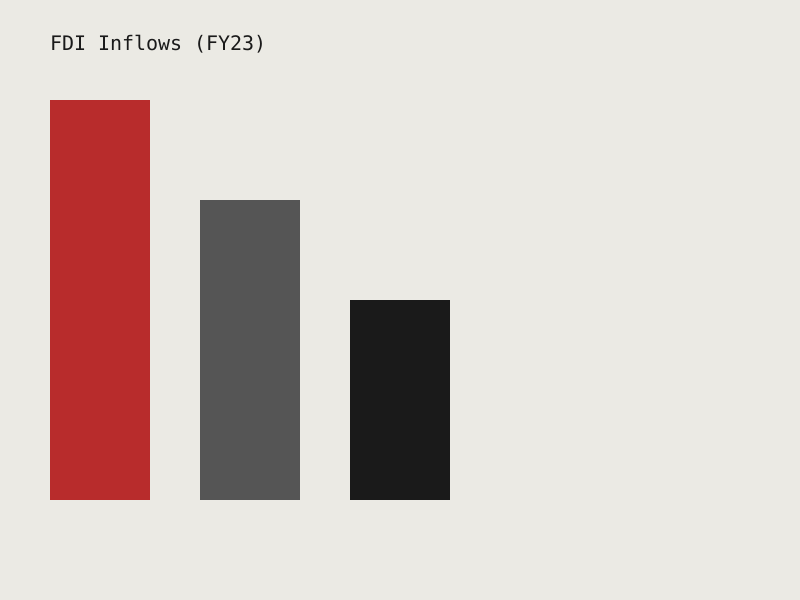
Growth without the hype.
India's macroeconomic numbers are widely cited: 7%+ GDP growth, a $3.5T economy, and massive demographic dividends. However, executing a market entry requires navigating a complex federal structure where policy is dictated centrally but executed locally.
The variance in infrastructure quality, bureaucratic efficiency, and labor laws between states like Tamil Nadu and Uttar Pradesh is equivalent to comparing different sovereign nations.
The China Plus One execution gap
While capital expenditures are flowing toward Indian manufacturing under PLI schemes, the supply chain depth remains shallow compared to Shenzhen. Expect higher logistics costs (13-14% of GDP) and mandatory local sourcing quotas in certain sectors.
- × Myth: Cheap labor equals cheap production.
- × Myth: Federal approval guarantees state compliance.
Macro & Regulatory Benchmarks
Trailing 12-month data, updated Q3 2024.
| Metric | Current Value | YoY Delta | Implication for FDI |
|---|---|---|---|
| Corporate Tax (Base) | 22% | 0% | Requires foregoing specific deductions. Effective rate ~25.17% w/ surcharge. |
| Rupee Volatility (INR/USD) | 3.2% | -1.1% | RBI intervention maintaining tighter bounds; impacts repatriation planning. |
| EPF Mandate Limit | ₹15,000/mo | 0% | Mandatory 12% employer contribution for base salaries under this threshold. |
| Avg Customs Dwell Time | 85 Hours | -12% | Improving via Faceless Assessment, but still lags ASEAN competitors. |
The FDI Route Map
India classifies foreign investment into two distinct regulatory routes. Misclassifying your sector results in severe FEMA (Foreign Exchange Management Act) penalties.
Read the FDI Policy GuideAutomatic Route
No prior approval required from the Government of India or RBI. Post-facto filing within 30 days is mandatory.
- ✓ IT & Software (100%)
- ✓ Manufacturing (100%)
- ✓ Healthcare & Pharma (100% Greenfield)
- ✓ E-commerce (Marketplace Model)
Government Route
Requires prior clearance from the specific administrative ministry. Timelines span 8-12 weeks minimum.
- ⚠ Defense (Beyond 74%)
- ⚠ Telecom (Security Clearance)
- ⚠ Multi-brand Retail (51% Cap)
- ⚠ All investments from border-sharing nations (PN3)
Realistic Setup Timelines
Consultants often quote "15 days" to incorporate. This ignores the reality of KYC apostillization, banking setup, and GST registration. Use our baseline calculator.
The Critical Path Bottlenecks
- 1. Document Authentication (Weeks 1-3)
- Foreign director passports and utility bills must be notarized and apostilled in their home country. This is the #1 delay factor.
- 2. Digital Signature Certificate (Week 4)
- Physical video verification is mandatory for all foreign directors to obtain a Class 3 DSC required for filing.
- 3. Corporate Bank Account (Weeks 6-8)
- RBI KYC norms are stringent. While incorporation happens fast, activating a current account to receive initial capital takes weeks.
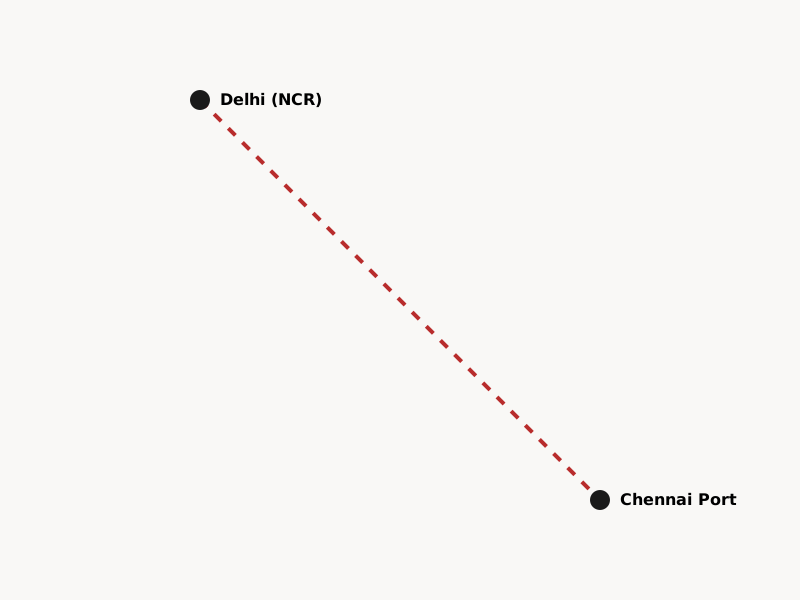
Industrial Corridors
Foreign capital does not flow to "India"—it flows to specific clusters. 70%+ of FDI is concentrated in just five states.
Maharashtra
Pune / Mumbai
The financial capital and legacy automotive hub. Highest FDI inflow historically.
- Ecosystem: Auto, Finance, IT
- Land Cost: Very High
- Labor Code: Stringent
Tamil Nadu
Chennai / Hosur
The "Detroit of Asia" transitioning to EV and Electronics (Apple ecosystem).
- Ecosystem: Hardware, Auto, SaaS
- Land Cost: High
- Labor Code: Favorable
Karnataka
Bengaluru
The undisputed tech hub. Highest concentration of R&D and GCCs (Global Capability Centers).
- Ecosystem: IT, Biotech, Aerospace
- Land Cost: Very High
- Labor Code: Moderate
Gujarat
Ahmedabad / GIFT
Aggressive incentive structure. Home to GIFT City (IFSC) and massive port infrastructure.
- Ecosystem: Chem, Finance, Renewables
- Land Cost: Moderate
- Labor Code: Very Favorable
Regulatory Delta
Policy in India moves rapidly via circulars and notifications rather than parliamentary acts. Monitor these critical vectors.
DPDP Act Enforcement
Q3 2024The Digital Personal Data Protection Act establishes strict consent frameworks and significant penalties (up to ₹250 Cr) for data breaches. Requires immediate compliance audits for consumer-facing entities.
PLI Scheme Expansion
OngoingProduction Linked Incentives expanded to IT Hardware (2.0) and specialty steel. Disbursement mechanisms remain complex, requiring strict audited value-addition proof.
Labor Codes Rollout Delay
PendingThe consolidation of 29 central labor laws into 4 codes remains pending state-level rule framing. Existing fragmented compliance burden remains in effect for FY24-25.
The First 365 Days
Statutory compliance in India is rigorous. Missing a filing deadline triggers automatic penalties and potential director disqualification. This is the non-negotiable baseline.
Full Compliance Calendar-
01
FDI Reporting (FC-GPR)
Must be filed with RBI via FIRMS portal within 30 days of share allotment.
-
02
GST Filings
Monthly returns (GSTR-1, GSTR-3B) are mandatory, even for nil revenue.
-
03
Statutory Audit
Mandatory external audit of financials, irrespective of revenue volume.
-
04
TDS Deduction
Tax Deducted at Source on vendor payments, filed quarterly.
"India is not a single market. It is a federation of 28 distinct administrative environments. The companies that fail here treat it as a homogeneous block. The ones that succeed adapt their supply chain to state-level realities."